Luna
Luna
2024 - 2025
Between hope and fear: Designing daily AI companionship for risky pregnancies
Between hope and fear: Designing daily AI companionship for risky pregnancies
Between hope and fear: Designing daily AI companionship for risky pregnancies
MY ROLE
Solo Designer
TIMELINE
3 Months
PRODUCT
Mobile App
TOOLS
Figma, FigmaMake
Why Luna Exists
Why Luna Exists
When my wife experienced PPROM (Preterm Premature Rupture of Membranes) at 18 weeks, we entered a world of medical terminology, uncertainty, and the long, anxious waits between high-risk OB appointments. Every two weeks felt like an eternity when you're monitoring for warning signs you barely understand.
After loss, preparing for the next pregnancy meant confronting a reality: the 14 days between appointments would be filled with questions, symptoms we'd second-guess, and fears we'd carry alone. I couldn't fix the medical reality, but I could design something to bridge those gaps, a companion that listens, educates, and holds space for the anxiety that comes with high-risk pregnancy after loss.
So I designed Luna.
When my wife experienced PPROM (Preterm Premature Rupture of Membranes) at 18 weeks, we entered a world of medical terminology, uncertainty, and the long, anxious waits between high-risk OB appointments. Every two weeks felt like an eternity when you're monitoring for warning signs you barely understand.
After loss, preparing for the next pregnancy meant confronting a reality: the 14 days between appointments would be filled with questions, symptoms we'd second-guess, and fears we'd carry alone. I couldn't fix the medical reality, but I could design something to bridge those gaps, a companion that listens, educates, and holds space for the anxiety that comes with high-risk pregnancy after loss.
So I designed Luna.
When my wife experienced PPROM (Preterm Premature Rupture of Membranes) at 18 weeks, we entered a world of medical terminology, uncertainty, and the long, anxious waits between high-risk OB appointments. Every two weeks felt like an eternity when you're monitoring for warning signs you barely understand.
After loss, preparing for the next pregnancy meant confronting a reality: the 14 days between appointments would be filled with questions, symptoms we'd second-guess, and fears we'd carry alone. I couldn't fix the medical reality, but I could design something to bridge those gaps, a companion that listens, educates, and holds space for the anxiety that comes with high-risk pregnancy after loss.
So I designed Luna.
What Luna Does
What Luna Does
Luna is an AI-powered pregnancy companion designed specifically for Canadian women in high-risk pregnancies who've experienced previous pregnancy loss. It lives between the doctor's appointments, offering daily check-ins, symptom tracking, educational milestones, and most importantly a judgment free space to voice fears at 2am when everything feels uncertain.
Luna is an AI-powered pregnancy companion designed specifically for Canadian women in high-risk pregnancies who've experienced previous pregnancy loss. It lives between the doctor's appointments, offering daily check-ins, symptom tracking, educational milestones, and most importantly a judgment free space to voice fears at 2am when everything feels uncertain.
Daily Check-Ins (Under 1 Minute)
Daily Check-Ins (Under 1 Minute)
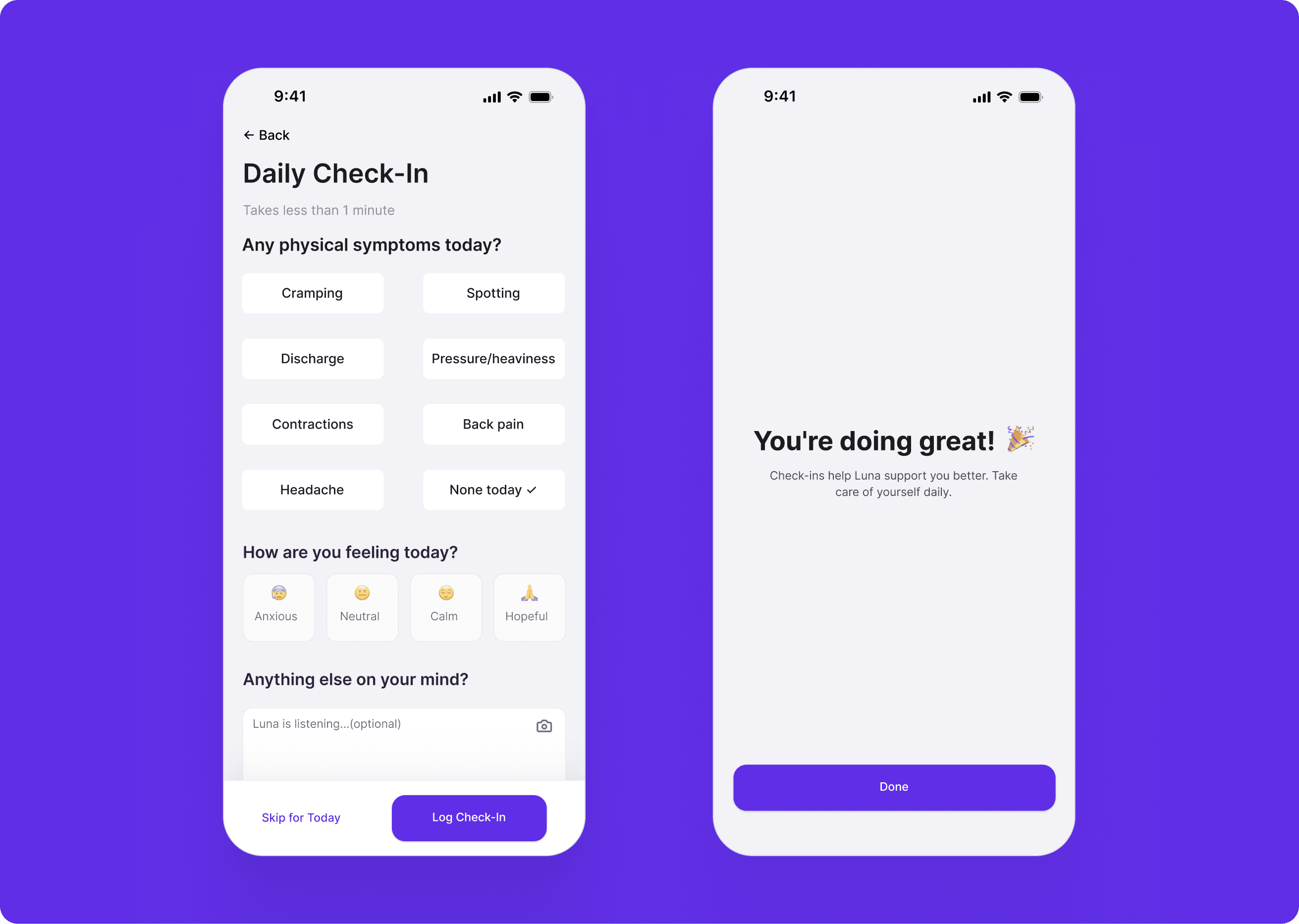
Every day, Luna asks: "Any physical symptoms today?" Users tap through options like cramping, spotting, or discharge, then answer "How are you feeling?" with emoji-based emotional check-ins. There's an optional space for "Anything else on your mind?" where Luna listens truly listens with voice or text input.
The interface is deliberately gentle. Soft purples, rounded corners, and a friendly mascot that feels more like a companion than clinical software. After each check-in, a simple "Congratulations 🎉" with encouragement reinforces that showing up matters.
Week-by-Week Milestones
Week-by-Week Milestones
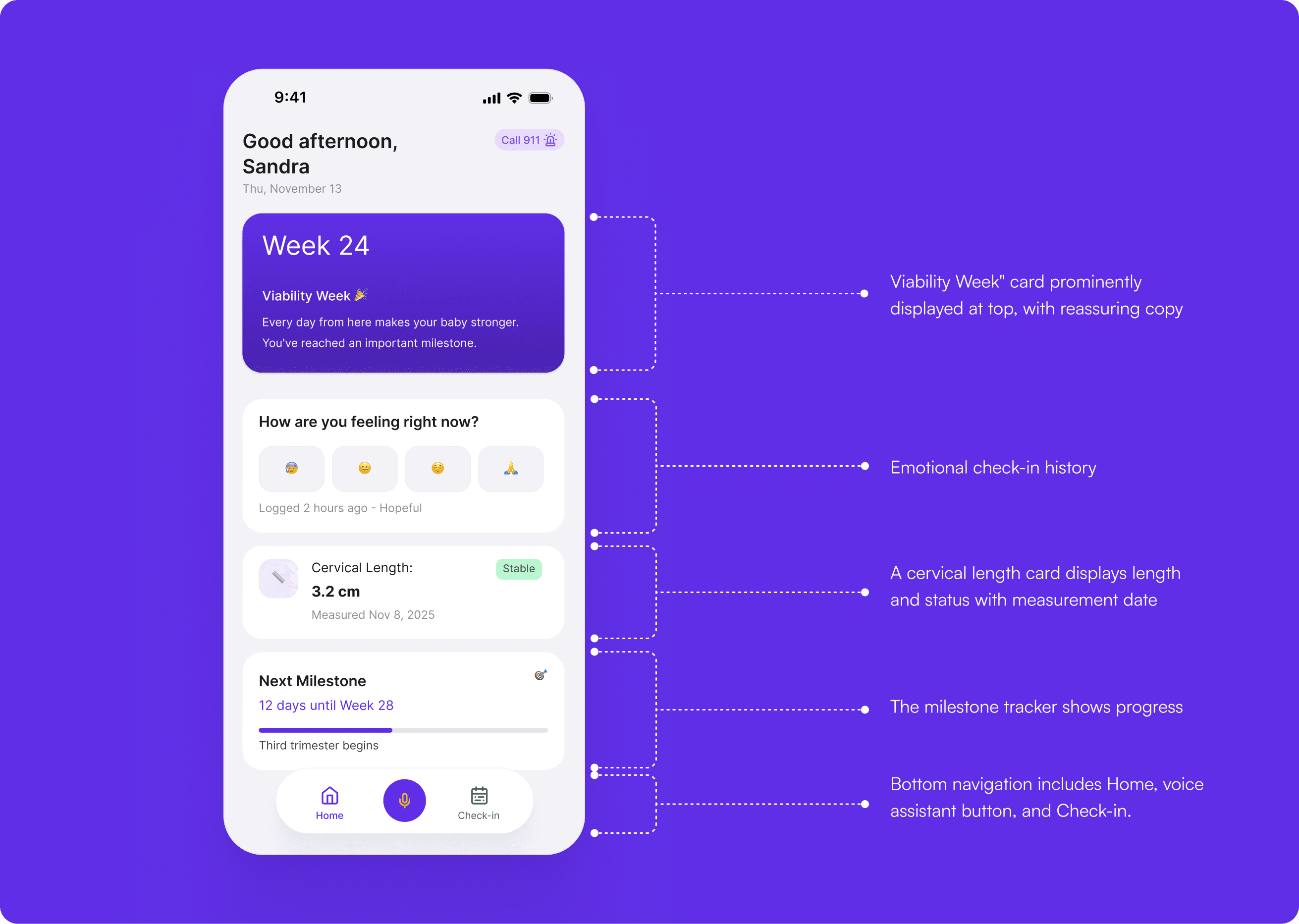
The home screen centers on the current pregnancy week "Week 24: Viability Week 🎉" with context about what's happening developmentally. For high-risk pregnancies, certain weeks carry enormous emotional weight. Luna acknowledges these milestones while tracking tangible medical markers like cervical length (displayed with status: "Stable" in calming green).
A progress bar shows "12 days until Week 28" with a note: "Third trimester begins." These aren't just calendar markers they're psychological checkpoints that high-risk patients cling to.
The home screen centers on the current pregnancy week "Week 24: Viability Week 🎉" with context about what's happening developmentally. For high-risk pregnancies, certain weeks carry enormous emotional weight. Luna acknowledges these milestones while tracking tangible medical markers like cervical length (displayed with status: "Stable" in calming green).
A progress bar shows "12 days until Week 28" with a note: "Third trimester begins." These aren't just calendar markers they're psychological checkpoints that high-risk patients cling to.
Voice Companion Between Appointments
Voice Companion Between Appointments
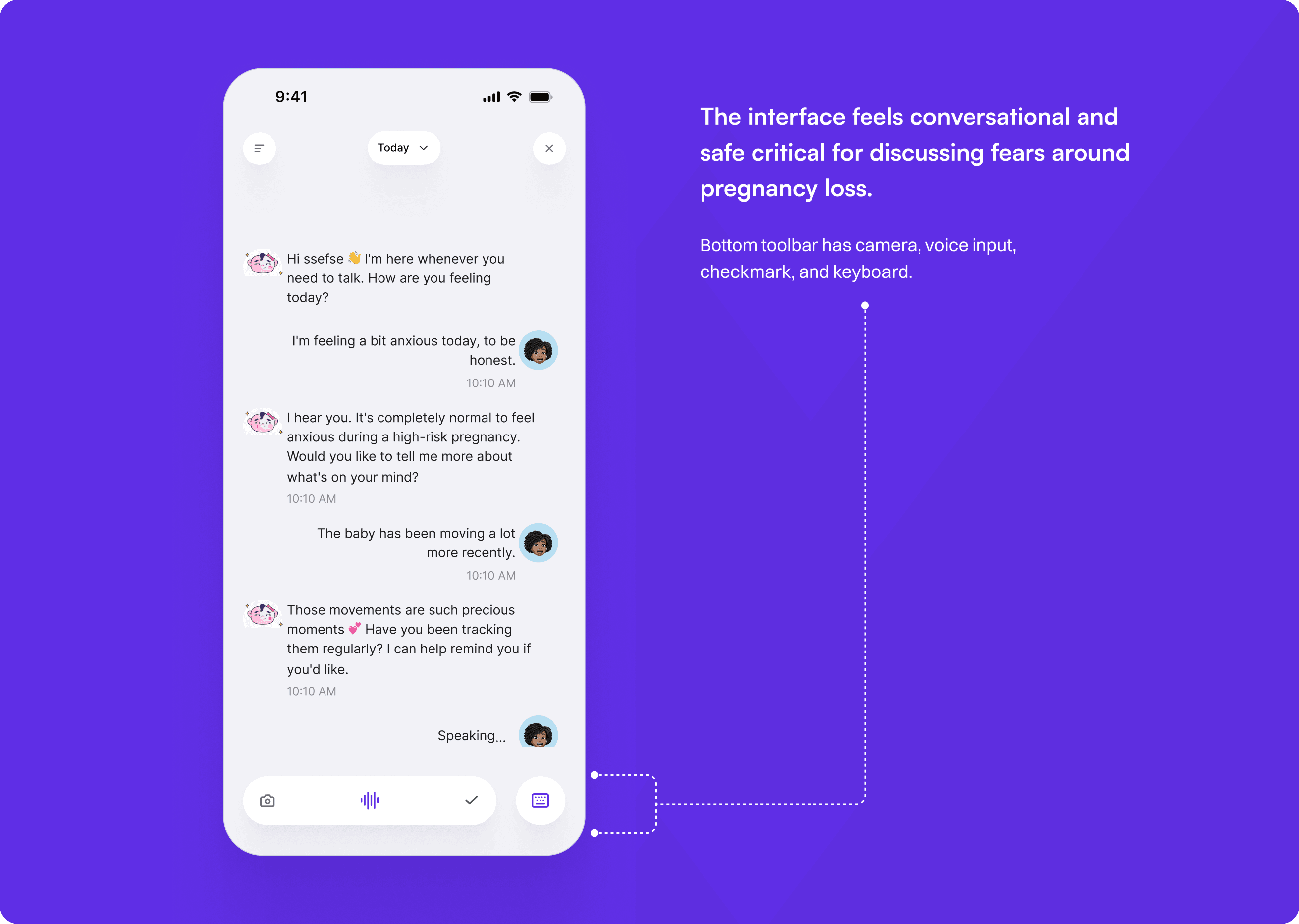
The voice chat interface lets users talk to Luna anytime. "I'm having cramping, should I be worried?" "I can't sleep because I'm anxious about next week's ultrasound." Luna responds with empathy first, medical context second, and always encourages calling 911 or the high-risk OB for concerning symptoms.
It's not trying to replace doctors. It's trying to be the knowledgeable friend who's been through it, available at midnight when worry spirals.
The voice chat interface lets users talk to Luna anytime. "I'm having cramping, should I be worried?" "I can't sleep because I'm anxious about next week's ultrasound." Luna responds with empathy first, medical context second, and always encourages calling 911 or the high-risk OB for concerning symptoms.
It's not trying to replace doctors. It's trying to be the knowledgeable friend who's been through it, available at midnight when worry spirals.
Onboarding That Honors Loss
Onboarding That Honors Loss
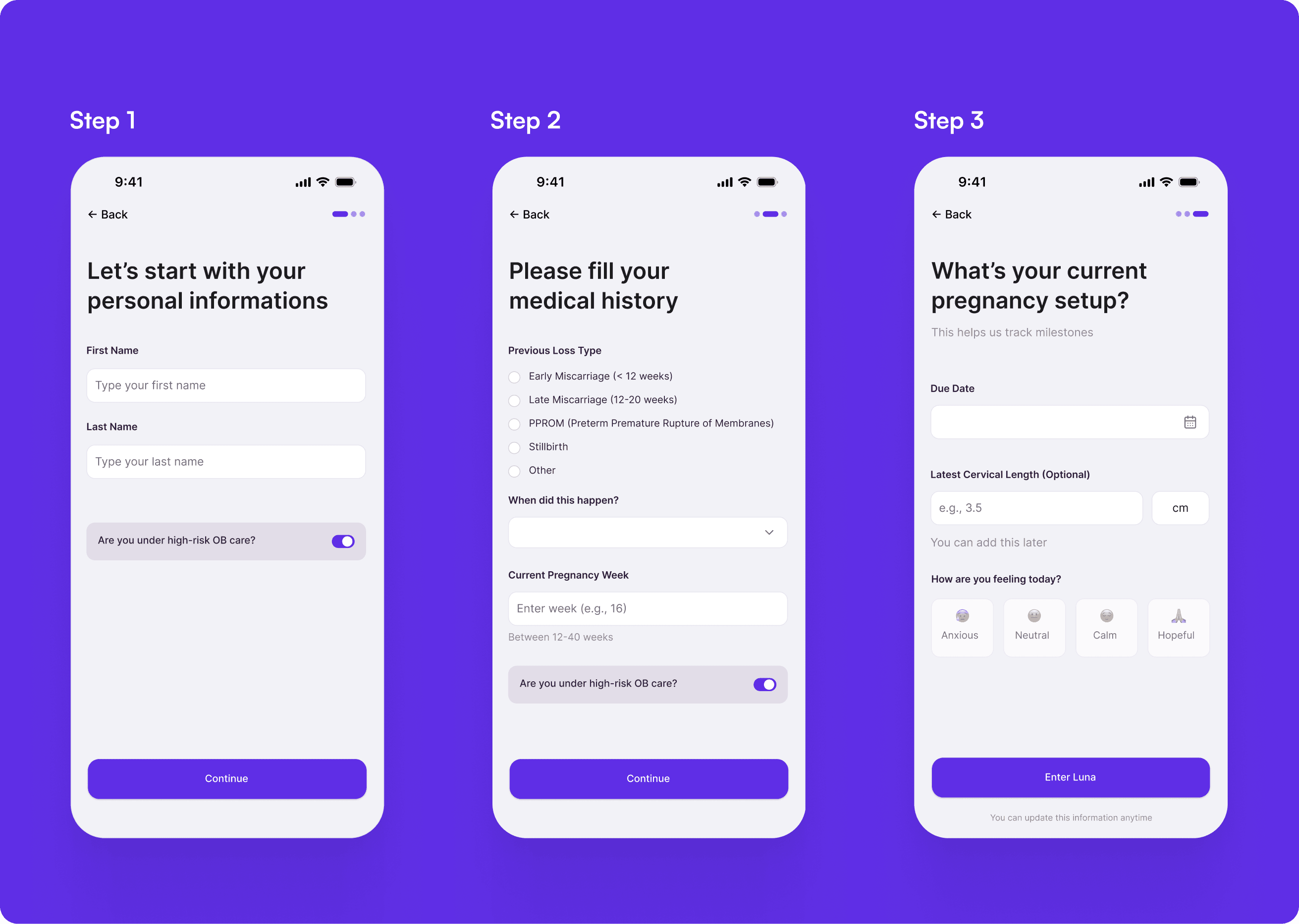
The setup flow collects essential medical history with care. Step 2 asks: "Please fill your medical history" with radio options for previous loss type (early miscarriage, late miscarriage, PPROM, stillbirth, other). It asks "When did this happen?" and "Current Pregnancy Week" to personalize milestone tracking.
There's a toggle: "Are you under high-risk OB care?" Because the app assumes yes, but validates that reality. Every field respects that users are carrying trauma while carrying hope.
The setup flow collects essential medical history with care. Step 2 asks: "Please fill your medical history" with radio options for previous loss type (early miscarriage, late miscarriage, PPROM, stillbirth, other). It asks "When did this happen?" and "Current Pregnancy Week" to personalize milestone tracking.
There's a toggle: "Are you under high-risk OB care?" Because the app assumes yes, but validates that reality. Every field respects that users are carrying trauma while carrying hope.
Behind the Work & Final Solution
Behind the Work & Final Solution
This project came from necessity, not portfolio ambition. I spent months researching high-risk pregnancy protocols, interviewing women in Rainbow Baby support groups (pregnancies after loss), and consulting with a perinatologist to ensure medical accuracy. I used FigmaMake to build a fully functional prototype complete with state management, conditional logic, and realistic data flows allowing me to test the experience.
This project came from necessity, not portfolio ambition. I spent months researching high-risk pregnancy protocols, interviewing women in Rainbow Baby support groups (pregnancies after loss), and consulting with a perinatologist to ensure medical accuracy. I used FigmaMake to build a fully functional prototype complete with state management, conditional logic, and realistic data flows allowing me to test the experience.
What I Want You to Know
What I Want You to Know
Designing for trauma requires restraint. Luna doesn't gamify pregnancy or use aggressive push notifications. It doesn't promise outcomes. It simply shows up, listens, and reminds users they're not alone in the uncertainty.
This project taught me that empathy-driven design isn't about solving every problem it's about being present for the ones you can't solve. Sometimes the best product is just a steady companion.
Designing for trauma requires restraint. Luna doesn't gamify pregnancy or use aggressive push notifications. It doesn't promise outcomes. It simply shows up, listens, and reminds users they're not alone in the uncertainty.
This project taught me that empathy-driven design isn't about solving every problem it's about being present for the ones you can't solve. Sometimes the best product is just a steady companion.